Over the past 30+ years the world’s tile industry transformed from a largely Eurocentric, semi-automatic, artisanal activity into the truly global hi-tech industry it is today.
Production technology has advanced in a series of significant leaps, including monocottura (single firing), monoporosa (dense body single firing), Rotorcolor rotary décor, atomised porcelain body prep and, latterly, digital ink jet printing technology.
Manufacturers have fought an escalating manufacturing arms race based on ball mills, atomisers, lances, cyclones, power co-generation systems and digital surface inspection. The resulting low-labour factories offer the balletic beauty of laser-guided kiln cars and pallet stacking robots; or awe-inspiring, ultra-fast and precise rectifying lines and polishing stations.
The progressive technical evolution of ceramic tile manufacturing shows no sign of slowing down. In the past few years the latest step-change has been the development of continuous compaction, where rollers – rather than moulds and vertical ram presses – compress the porcelain dust to make today’s mega-format slabs or, as our colleagues in the USA now term them, gauged porcelain panels.
Two of the giant’s of tile manufacturing technology – Sacmi and Sit B&T – led the way. Sacmi, with first Continua and now Continua+ developed an innovative compaction technology that broke through productivity barriers for large size tiles.
Continua+ allows the manufacture of porcelain slabs and tiles in a wide range of sizes and thicknesses, decorated both on the surface and in-body, at far higher output rates than those attainable with traditional processes.
Sacmi offers Continua+ lines with powder-based digital decoration systems and ‘on the move’ tile cutting systems. At the heart of each Continua+ line is a continuous compactor that allows manufacturers to form slabs that have a strength and density even greater than those attainable via traditional pressing. Cutting stations incorporated into the line allows manufacturers to produce a full range of sizes simply by adjusting a few settings.
Iris, Ariostea, Graniti Fiandre, Co-Operativa Imola, Iris, Fincibec, RAK, Nord Ceram and Steuler are just some of the leading manufacturers that use this technology.
Until recently, the main rival was Supera by Siti B&T. Supera is highly flexible and versatile in terms of thicknesses (from 5 to 25mm). Rather than just a pressing technology for large-size tiles and panels, Supera is the heart of a complete production line consisting of cutting-edge technological solutions. It is highly flexible and can produce ceramic slabs up to 1,200 by 3,600mm; and their submultiples.
Supera is equipped with three hydraulic pistons designed to guarantee uniform shaping on the edges and splitting of the panels to minimise deformation during pressing. A key feature of Supera is XXL Green Cut, a cutting machine for unfired ceramic slabs up to 4,000 by 1,350 mm equipped with a transverse and longitudinal row of disc cutting units to cut the slabs in both directions and at positions that can be set via the touch-screen control unit.
As a result of these technologies, thin, large porcelain slabs – which can be used to cover all manner of surfaces including worktops and furnishings – are now available in sizes up to 1,600 by 3,200mm from companies like Floor Gres, Fondovalle, Caesar, AVA, Casamood, Flaviker, Floor Gres, La Fabbrica, Leonardo and Mirage.
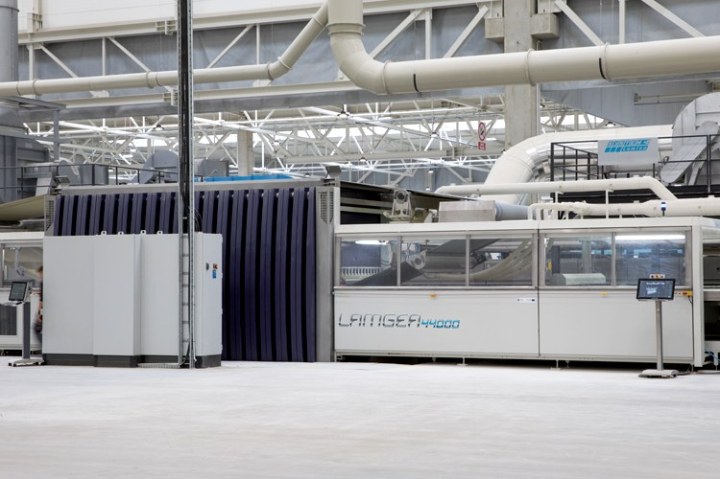
The latest player in this cutting-edge market is another giant in the world of ceramic production plant; System. Developed by System’s Lamina division; Lamgea is a mouldless press, capable of manufacturing slabs up to 4,800 by 1,600mm using standard atomized porcelain powders. It is possible to create any effect on the slabs, even structured surfaces with a relief up to 2mm, digital decorations and 3D effects. Since the belt slides on the press, users can create different structures on a slab surface up to 16 metres long. This means that three concurrently produced slabs, each 4,800 by 1,600mm, can each look completely different.
Lamgea is billed as a revolutionary way of creating ceramic products, without moulds and with no format limits. A key selling point is the flexibility regarding thickness: from 3 to 30mm, depending on the product’s intended use.
So Lamgea proposes that tile companies, using a single a large slab, can produce all the sizes required, in any thicknesses required. The secret is Lamgea’s ability to ‘green’ cut the unfired slabs, measuring up to 4,800 by 1,600mm, into the desired sub-formats. Manufacturers can also choose the thickness of the slabs depending on the intended use: floors, walls, worktops, furniture, architecture or interiors.
Lamgea claims to offer many benefits including thinner slabs that need less raw material, less firing energy and produce less waste. The resultant slabs are also lighter per sq. metre and thus easier to install. They are also easier to cut.
System claims that when a Lamgea slab comes out of the kiln, the shape is 100% regular without any gauge defects due to this perfect and uniform pressing method.
There are already more than 20 Lamgea plants operating globally; and the last statistics show that more than 35,000,000 sq. metres of tiles are already being made annually using Lamgea technology.
And adoption of this hi-tech system is far from being concentrated in Europe, as one might expect. For instance New Pearl, billed as the largest ceramic tile manufacturer in China, has selected Lamgea technology to enter the ultra large-format ceramic panel segment, aiming to become the main local producer of this type of product.
Another convert is Gold Medal, a Chinese company that specialises in the production of high quality glazed tiles. It has installed the Lamgea system in the Guangdong Gold Medal Ceramics factory at Foshan.
On stand after stand at Cersaie, wall and floor tiles were shown alongside kitchen worktops, bathroom vanity tops, tile-clad furniture, tables with one-piece ceramic tops, and more. This was also true of factories, like Grespania, who have in-house Laminam plants. Once again, this 3mm material is now being produced in the same designs as porcelain floor tiles and white body wall tiles.
Today’s ceramic tile factories can not only compete on size and price with composites and natural stone, but digital printing technology means that simulations of really fragile stones, or minerals rarely found in large enough seams for a one piece worktop, can now be simulated in a material with better technical performance, especially in areas such as stain- and scratch-resistance.
While there is definitely a place for these mega-formats in the traditional tile installation segment, architects and other specifiers will need to adopt radical new material strategies if to take full advantage of these incredible new mega tiles. Kitchen worktops is one obvious starting point, but the range of potential applications is extensive and growing.
Mouldless Milestone
The latest technology to hit the headlines is Superfast from System Ceramics. Flexibility, high speed, and sustainability are the key features of Superfast: billed as the first ceramic press in the world without a mould. Superfast can to produce, in a simple, flexible and rapid manner, all formats of porcelain stoneware starting from 600, 800, and 900mm modules in thicknesses from 3 to 30mm … and is said to achieve nominal productivity of more than 16,000 sq. metres per day.
Due to the absence of a mould, the Superfast press ensures maximum flexibility in the change of format, which occurs completely digitally via software without any mechanical intervention and without having to change the belt. It is achieved, instead, with a simple operation that resets a number of parameters, making format changes very rapid. This puts this pressing technology at the cutting-edge and is said to make it unique in the world. In addition, because there is no mould, all formats can be produced on a single belt, thereby significantly reducing production costs.
From a sustainability angle, Superfast makes a fundamental contribution in the recovery of ceramic material coming from the pressing and cutting phase. The recovered material is dry ground directly at the side of the press, and is then mixed and dosed so that it can be introduced directly into the dosers of atomized coating material, and reused in production without having to pass to the atomizer. This recycling process is made possible by an unfired cutting system, that allows the slab to be cut after pressing and before introduction into the kiln.
This operation is managed by software that makes it possible to dose appropriate percentages of the recovered material and new atomized material coming from other silos. It is thus possible to reuse – in real time – the entire recovered component, mixing it into the lower layer, contributing significantly to the creation of the overall thickness of the ceramic product. By reduce the quantity of material required for ceramic production, the Superfast system can deliver significant savings in raw material use.
The environmental sustainability of the process is also underpinned by very low energy consumption in the pressing phase; 70% less than traditional ceramic presses.
This development reflects System Ceramics’ objective of offering the global market technologies with increasingly flexible high level performance, that can satisfy a manufacturing sector that requires lean and rapid processes, reduced production costs, and just-in-time production oriented towards product customisation.

 Transformational Tile Technology